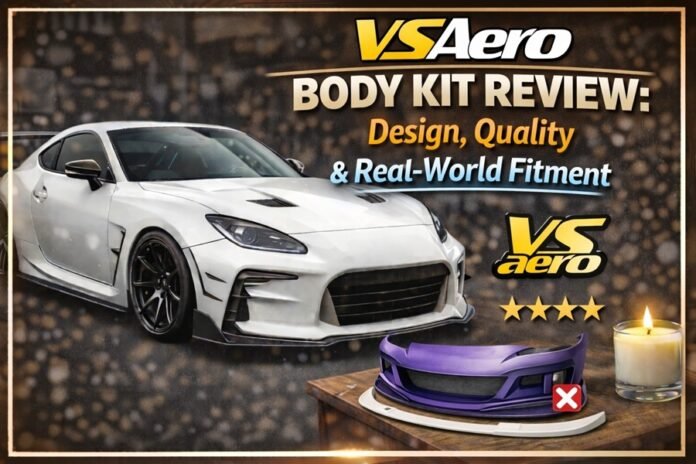
For enthusiasts looking to transform a “stock” commuter into a track-ready beast, the search often leads to vsaero body kit. Known for their aggressive widebody kits and drift-inspired aesthetics, VSAero has carved out a significant niche in the aftermarket aero world.
But does the “budget-friendly” price tag mean you’re in for a fitment nightmare? In this comprehensive review, we break down the design, material quality, and what it’s actually like to install a VSAero kit in your garage or shop.
1. Design & Aesthetic Appeal: The “TKYO” Factor
VSAero is best known for its TKYO and VAR series. Their design philosophy leans heavily into the “Time Attack” and “Pro Drift” look.
-
Aggressive Stance: Most VSAero kits feature massive fender flares (often 40mm to 80mm wider than stock) and integrated front splitters.
-
Modern Styling: Unlike older kits that can look dated, VSAero designs mimic modern aero trends seen on the Formula Drift circuit.
-
Variety: They support a wide range of platforms, including the Nissan 350Z/370Z, Subaru BRZ/FR-S, Mazda Miata, and BMW E36/E92.
The Verdict: If you want your car to look like a SEMA showpiece, VSAero hits the mark. The lines are intentional, and the proportions generally complement the original body lines well.
2. Material Quality: Understanding FRP
The majority of VSAero kits are made from Fiberglass Reinforced Plastic (FRP). It’s important to understand what this means for your build:
| Feature | Performance | What to Expect |
| Durability | Moderate | Stiffer than polyurethane; will crack rather than flex upon impact. |
| Weight | Lightweight | Significant weight savings over OEM steel panels. |
| Finish | Primer Ready | Arrives in a white or gray gel coat/primer. |
| Consistency | Hand-Layup | Being hand-laid, thickness can vary slightly between pieces. |
Pro Tip: VSAero products are designed for “off-road and show use.” This is industry-speak for: It’s going to take work to make it perfect.
3. Real-World Fitment: Expectation vs. Reality
This is where most owners get frustrated. Is VSAero a “bolt-on” kit? No. Almost all VSAero kits are classified as Performance/Custom fitment. Based on community feedback and professional shop reports, here is the reality of the fitment:
The “Dry Fit” Phase
You should never paint a VSAero kit straight out of the box. A “dry fit” is mandatory. You will likely encounter:
-
Surface Imperfections: Minor chips, waves, or “spider cracks” in the gel coat are normal for FRP and are intended to be sanded out during prep.
-
Mounting Holes: These are rarely pre-drilled. You will need to align the part and drill your own mounting points.
-
Trimming & Shaving: To get tight panel gaps, you will likely need to shave the edges of the fiberglass or use body filler (Bondo) to level out transitions.
Widebody Specifics
If you are installing a widebody kit, be prepared to cut your OEM metal fenders. This is necessary to allow for wheel travel under the new, wider flares.
4. Pros and Cons: A Quick Look
Pros
-
Price Point: Significantly more affordable than authentic Japanese brands like Rocket Bunny or Liberty Walk.
-
Availability: Usually stocked in the US, avoiding 6-month wait times and astronomical shipping from overseas.
-
Style: High-end aesthetic for a mid-range budget.
Cons
-
Labor Intensive: The money you save on the kit might go to your body shop in labor hours for prep and fitment.
-
FRP Fragility: Not ideal for daily drivers in areas with high curbs or heavy snow.
-
Hardware Not Included: You’ll need to source your own rivets, bolts, and 3M tape.
5. Is a VSAero Kit Right for You?
Choose VSAero if: You are building a show car or a dedicated track/drift car, and you (or your shop) have experience working with fiberglass. The value proposition is unbeatable for the look you get.
Skip VSAero if: You want a kit that you can bolt on in your driveway Saturday morning and drive to a meet on Saturday night. If “perfect fitment” to you means “OEM-like ease,” you may want to look into polyurethane lips or higher-end dry carbon options.